
Conceived on the polo fields of India in the early 1930s and perfected in the Swiss Vallée de Joux, the Jaeger-LeCoultre Reverso remains one of watchmaking’s most enduring icons. Inspired by the challenge to create a timepiece capable of surviving the rigours of polo while retaining elegant Art Deco design, the Reverso has evolved into a symbol of duality — sport and refinement, artistry and engineering, East and West. This story traces its remarkable journey from colonial India to the ateliers of Switzerland, and the creative legacy that continues to shape it today.
Among the earliest bespoke commissions was the Maharani Reverso of 1936, a jewel-like creation reflecting the patronage of Indian royalty and the precision of Swiss watchmaking.
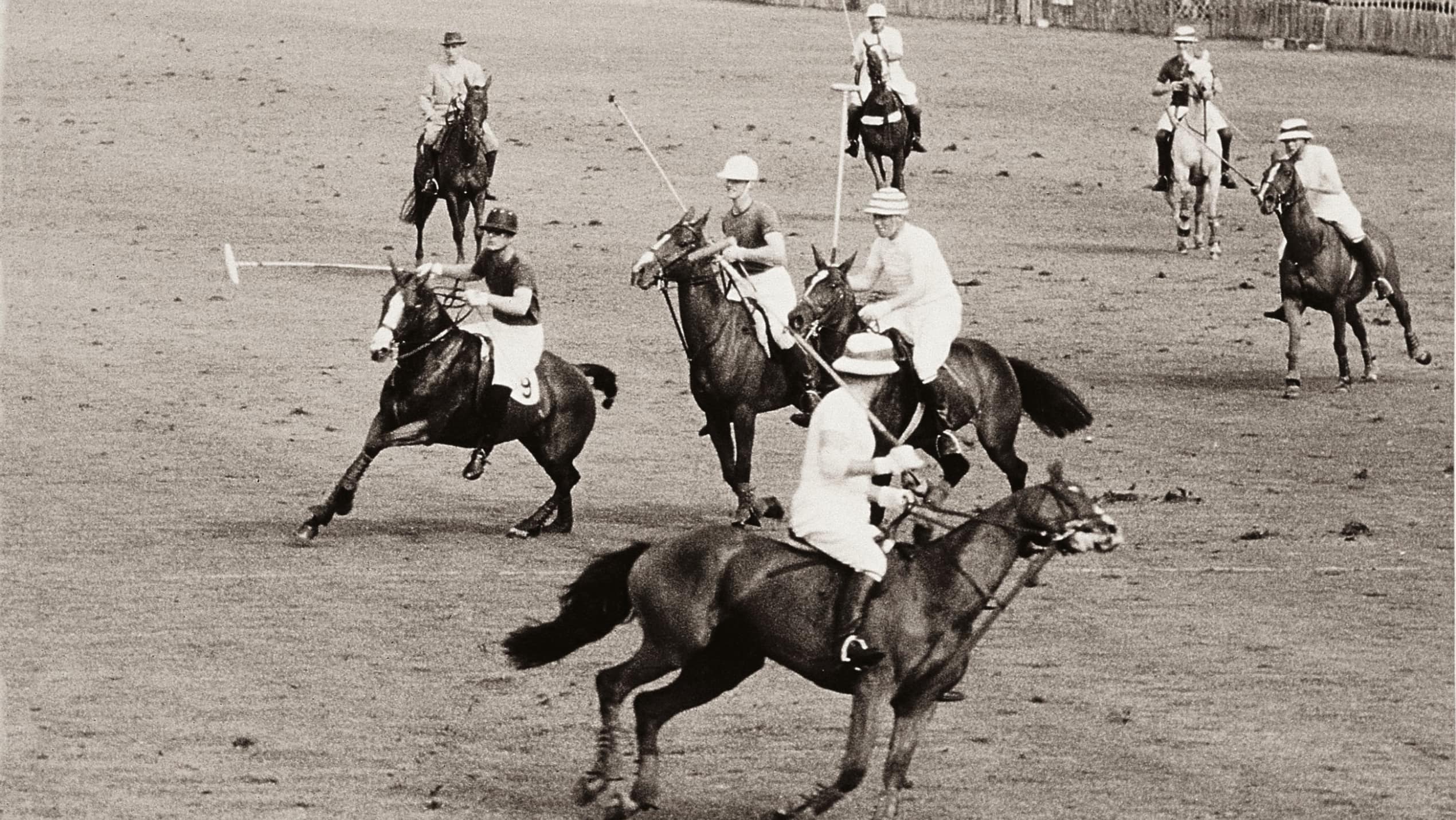
Jaeger-LeCoultre’s Reverso, born on the polo fields of India in the early 1930s, remains one of watchmaking’s most enduring icons. British army officers, their wrists strapped with delicate timepieces, galloped through the dust only to finish each chukka with shattered watches. Polo demands precision: players must keep track of the seven-minute periods that structure each match’s six chukkas.
In the winter of 1930–31, after one such match, an officer challenged Swiss businessman and watch collector César de Trey to devise a timepiece robust enough to withstand the rigours of the sport and the realities of military life. Intrigued, de Trey presented the idea to his friend Jacques-David LeCoultre, owner of LeCoultre & Cie, founded in 1833 in the Vallée de Joux, Switzerland. Together, they envisaged a watch that could quite literally turn time on its head.
LeCoultre enlisted Jaeger S.A., the Paris-based firm of Edmond Jaeger, a renowned watchmaker who supplied chronometers to the French navy. Jaeger then commissioned French designer René-Alfred Chauvot to engineer a case that could slide in its frame and flip over to shield the dial. On 4 March 1931, Chauvot filed a patent in Paris for “a watch capable of sliding in its support and being completely turned over.” By July, de Trey had secured the rights to the design, and in November he registered the name Reverso — Latin for “I turn around.”
César de Trey and Jacques-David LeCoultre quickly formalised their partnership and began production, creating an elegant rectangular timepiece with a dial that could be protected in a single gesture, while the blank metal verso offered a discreet canvas for personalisation. Remarkably, the first Reverso was available less than nine months after the patent was filed. Two years later, LeCoultre introduced a dedicated movement, the Calibre 410, tailored to the Reverso’s unique case. In 1937, Jaeger S.A. and LeCoultre officially merged, forming the maison we know today as Jaeger-LeCoultre (JLC).
Launched in 1931, the Reverso appeared at the height of the Art Deco movement. Its rectangular geometry, polished gadroons and golden-ratio proportions perfectly mirrored the modern elegance of the era. The design embodied technical ingenuity: clean lines, symmetry and form in the service of function.
What made the Reverso extraordinary was its duality — rugged yet refined, practical yet poetic. As the watch gained popularity among European elites, it also found admirers in India, where the British Raj’s sporting circles and the subcontinent’s aristocracy shared a fascination with craftsmanship and modernity. Among the earliest bespoke commissions was the Maharani Reverso of 1936, believed to have been created for an Indian royal with its jewel-like enamel work reflecting the meeting of Indian opulence and Swiss precision.
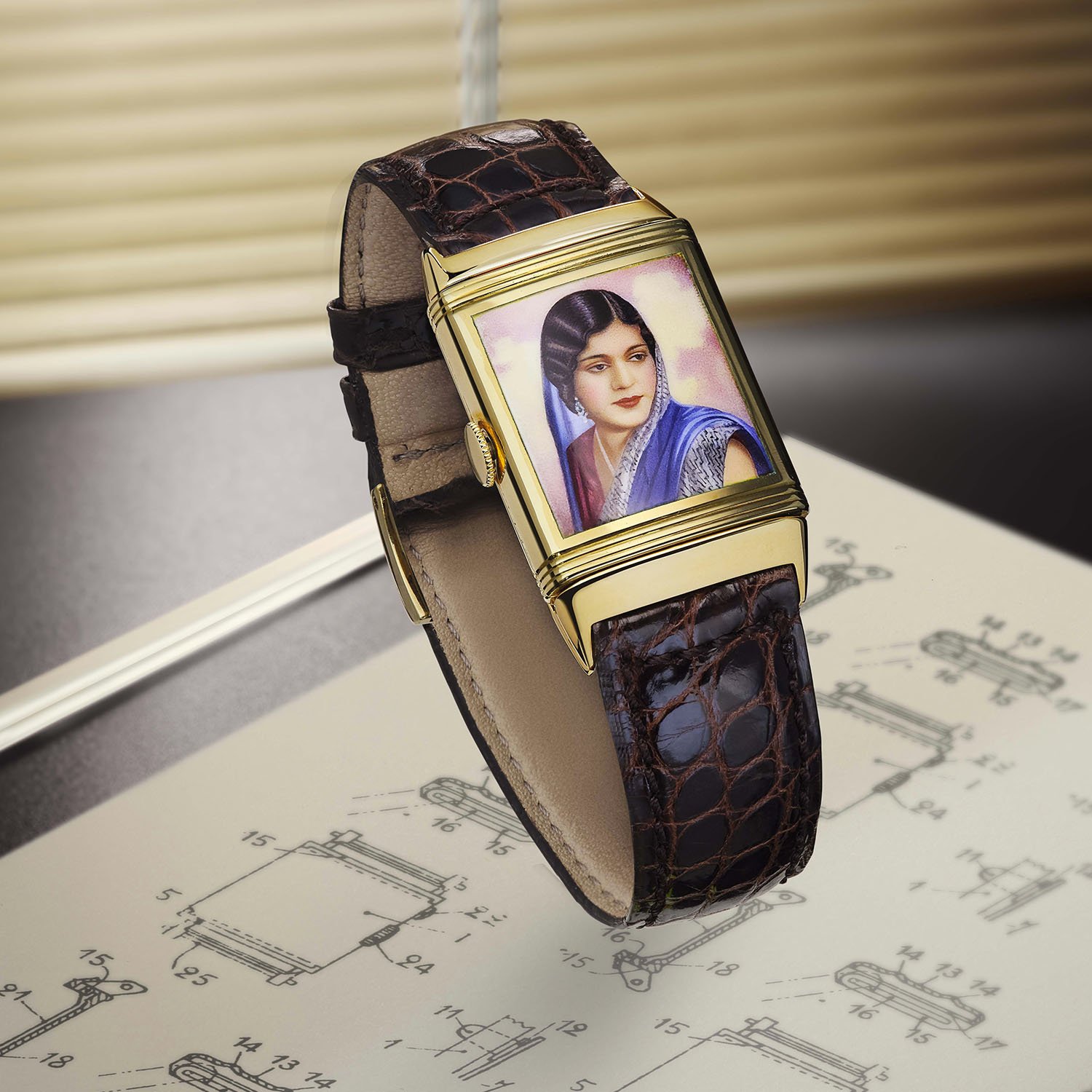
The Reverso’s genius extended beyond protection. It offered a surface for expression. What began as a plain steel verso soon became a canvas for engraving, enamel work and miniature painting. At the maison’s Atelier des Métiers Rares, artisans revived time-honoured decorative techniques such as grand feu enamel, guilloché and hand-engraving, transforming the watch into a wearable objet d’art.
Recent editions have paid tribute to masters of Western art: for example, a Van Gogh Reverso, its enamel capturing the painter’s vivid brushwork; a Seurat Reverso, recreating “A Sunday Afternoon on La Grande Jatte (1884)” in more than seventy hours of hand-painting, and Gustav Klimt’s “Portrait of a Lady (1916-17)” rendered in green enamel over barleycorn guilloché. Each piece, uniting time and artistry, is crafted with reverence in the quiet ateliers of Le Sentier.
By the 1940s, as round watches came into fashion and global events shifted priorities, the Reverso faded from prominence. It slipped quietly into dormancy, a legend waiting in the wings. Then came the quartz crisis of the 1970s and 80s, a turning point that compelled maisons to rediscover and defend mechanical watchmaking. In this period, Jaeger-LeCoultre revived the Reverso with renewed purpose. A water-resistant case arrived in 1985, followed by both quartz and mechanical movements, and eventually high-complication models such as the first tourbillon Reverso in 1993, the minute-repeater in 1994, the retrograde chronograph in 1996 and the perpetual calendar in 2000. The Reverso returned not as an echo of the past, but as a technical and aesthetic triumph.
Today, more than fifty Reverso models, from the Ultra Thin Tribute to the Duoface and the intricate Duetto complications, comprise the current collection. The maison continues its partnership with Casa Fagliano, the renowned Argentinian polo bootmaker, whose leather straps honour the watch’s equestrian origins.
Around the world, Jaeger-LeCoultre continues to present exhibitions dedicated to the Reverso’s legacy, from New York to Shanghai, celebrating more than ninety years of design and innovation. The Reverso remains a dialogue between cultures and eras — conceived amid the spirited polo fields of India, perfected in the Swiss mountains, and admired globally.
In a single swivel of its case, the Reverso distils nearly a century of artistry, engineering and storytelling. It was born of a challenge on Indian soil, shaped by the ideals of Art Deco modernity, and preserved by the artisans of Jaeger-LeCoultre. To turn the Reverso is to witness a rare harmony between worlds — East and West, sport and artistry, past and present. Time, once linear, becomes circular. And in that graceful reversal, the Reverso reminds us that elegance lies not only in how we move forward, but in how beautifully we can turn back.
Story by Rupi Sood
Sources: Jaeger-LeCoultre Press Office; Fratello Watches; WatchProSite; Watchonista; Monochrome Watches; Watches of Switzerland; Forbes; Outlook India.
All images courtesy of Jaeger-LeCoultre unless otherwise noted.
Key historical moments in the Jaeger-LeCoultre brand's rise to a modern day atelier committed to craftsmanship, heritage, and artistic expression.
The Reverso is the synthesis of form and function, a design based on a fundamental idea: it’s reversal, making it one of the most inventive wristwatches in history.
Lionel Favre, Head of Design at Jaeger-LeCoultre