
Few artists navigate the space between history and the present as seamlessly as Shazia Sikander. At TEFAF New York 2026, her monumental glass mosaic The Hour Glass (2025), presented by Sean Kelly Gallery, becomes a meditation on rootedness and feminine identity across borders and generations.
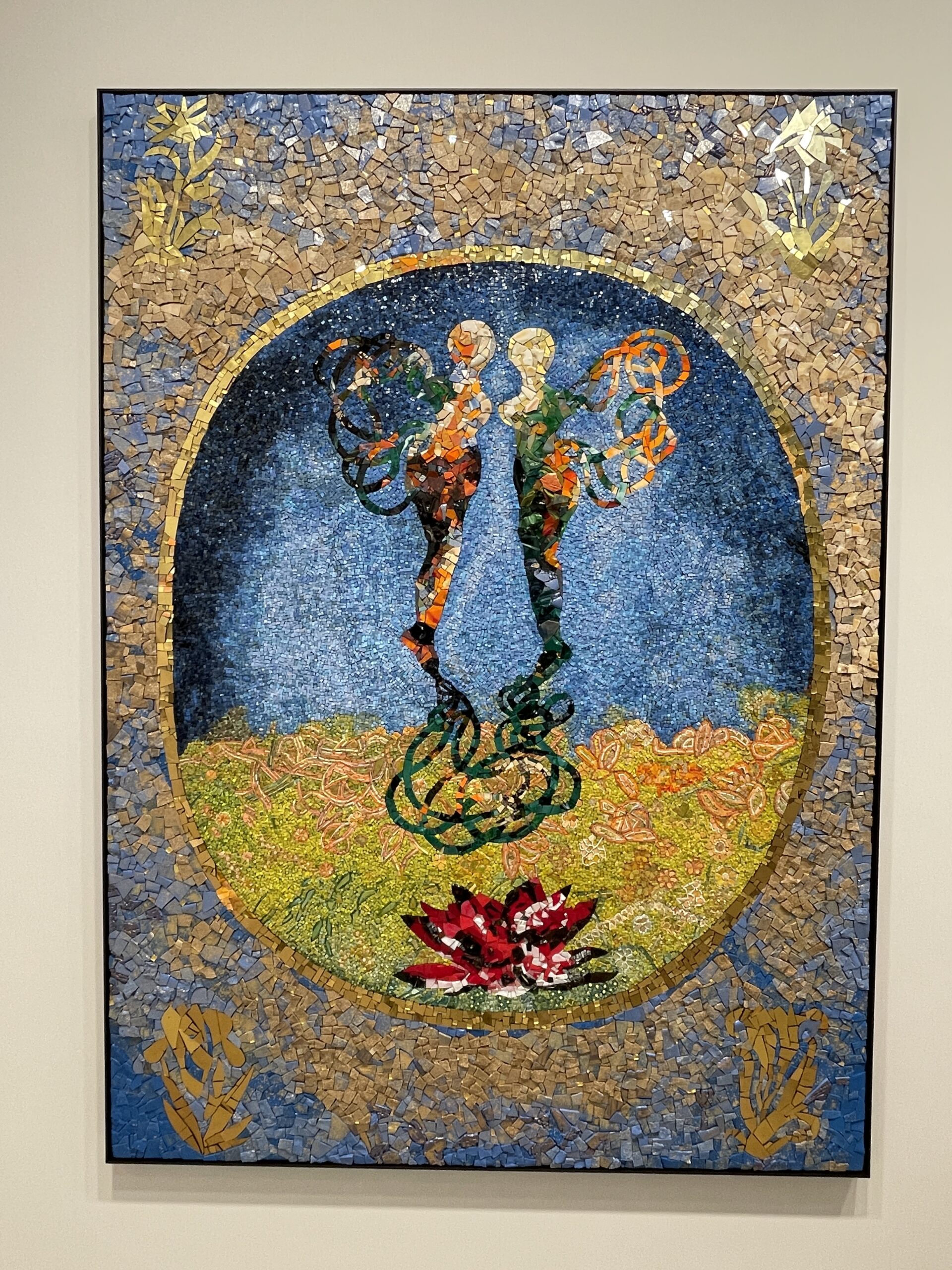
“The Hour Glass” (2025) Glass mosaic with patinated brass frame
84 × 60 3/4 × 2 in | 213.4 × 154.3 × 5.1 cm
Shazia Sikander’s The Hour Glass (2025), presented by Sean Kelly Gallery at TEFAF New York 2026, is a commanding work that more than merits the attention it has been receiving.
Born in Lahore, Pakistan in 1969 and based in New York since the early 1990s, Sikander received her BFA from the National College of Arts in Lahore in 1991 and graduated with a MFA from the Rhode Island School of Design in 1995. Over the course of her career, she has exhibited extensively with works spanning across various media such as painting, printmaking, sculpture, and video installation.
Throughout her practice, Sikander has revisited historical narratives through a contemporary lens, challenging inherited archetypes within art history while interrogating prescribed roles assigned to women and rigid notions of an East-West divide. Her earliest works emerged through a radical reinterpretation of Indo-Persian miniature painting traditions, most notably in the now-iconic The Scroll (1989–90), which brought her widespread recognition in the art world.
Over the years, she has developed a distinctive visual language in which fluid female forms and recurring symbolic motifs move through layered compositions that collapse geography, memory, and time.
The use of glass mosaic in The Hour Glass (2025) introduces a striking new dimension to this visual vocabulary. Unlike the delicacy and intimacy historically associated with miniature painting, mosaic carries a sense of monumentality and permanence. Light becomes an active component of the work, causing the surface to shift depending on the viewer’s movement and vantage point. The fractured materiality of glass also echoes many of the tensions embedded within Sikander’s practice: fragmentation and continuity, migration and rootedness, rupture and renewal.
The Hour Glass (2025) is composed entirely of custom hand-cut glass pieces and the work grapples with themes of time, history, and cyclical movement. Her familiar female forms with their limbs rendered as intricately entangled networks continue a longstanding metaphor of rootedness that has recurred throughout her practice. These floating figures suggest that women’s identities and cultural inheritances cannot easily be erased, displaced, or silenced; they carry memory, lineage, and continuity within themselves.
The lotus, another recurring motif in Sikander’s visual language, evokes humility, spiritual awakening, and a sense of shared humanity across cultures. Meanwhile, the work’s cyclical forms gesture toward infinity and resist restrictive binaries, reinforcing the artist’s ongoing exploration of identity, migration, and transformation.
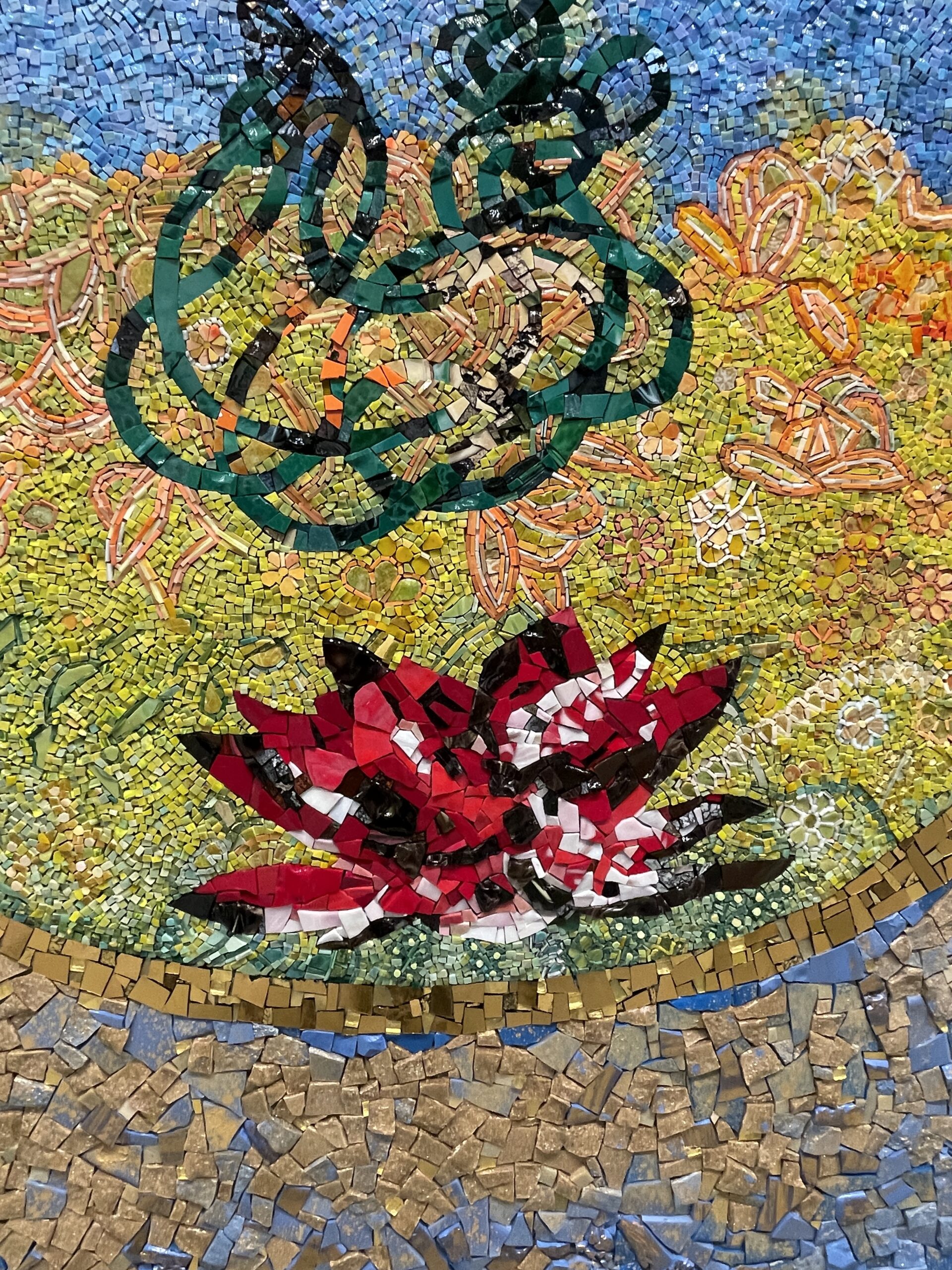
Detailed view of “The Hour Glass” (2025)
Despite its complexity, The Hour Glass (2025) possesses a remarkable sense of rhythm and fluidity, drawing the viewer into a suspended space where historical references and contemporary realities coexist simultaneously. Rather than offering fixed interpretations, Sikander leaves space for ambiguity, allowing the work to unfold gradually through repeated viewing.
At TEFAF New York 2026, The Hour Glass (2025) stands not only as a continuation of Sikander’s evolving visual language, but as one of the fair’s most compelling meditations on memory, femininity, and cultural continuity.